


Who Are You, Lord?
- bordenmscott
- Oct 19, 2022
- 8 min read
Updated: Oct 25, 2022
Can Jesus be Lord if you misunderstand who He is?

The Overflow is back! This is my space to explore things that just didn’t fit into Sunday sermons or other teaching and preaching but which I think are worth a look. It’s a place to chase connections, think a little more deeply about how theology and our world overlap, and to unravel trickier issues in the detail they deserve. It you can tolerate a certain amount of nerdery I believe the Overflow can help people think some things through, and I welcome input and feedback using the comment section or through whatever channel you’d prefer to reach out to me. There is also a short devotional at the end of my Overflow posts, usually connected to the topic in some way.
So here we go! And I’m supposed to pick a mildly provocative title or statement to get a few people to keep reading, so here it is again if you missed it up front: Can Jesus be Lord if you misunderstand who He is?
Last month the newest update of the “State of Theology" survey was released by LifeWay Research and Ligonier Ministries. It is pretty concerning to me, as a religious teacher, since it finds that a strong majority of regular church attenders in the United States are heretics.
I don’t mean heretic in an angry “burn them!” kind of way. I mean that they believed things that are in opposition to some pretty core traditional teaching of the Christian church that have been consistently held through Church history. I’m not angry about that, I’m just disappointed. This reveals a clear weakness in the approach being taken to teaching and discipleship in the Church. I don’t have equivalent data, but my suspicion is that theological knowledge north of border in Canada isn’t any better, and is probably worse in certain ways.
The answers given to some of the 35 questions in this survey were fine. But the Trinity is definitely tripping people up. Not only were many answers unorthodox (that’s gentler than “heretical”), they were often at odds with the answers to other questions.
For example, 83% of the most frequent church-attending people surveyed agreed that “there is one true God in three persons: God the Father, God the Son, and God the Holy Spirit.” That’s core nature of God/Trinity stuff, and is the orthodox (right believing) answer.
But then 59% of that same group later agreed with the statement “Jesus was a great teacher, but he was not God.” (I tackled that flawed idea in this week’s message, which you can find here.)

Huh? A bunch of people agreed with both statements. Is Jesus God, but also not? Is there confusion about Jesus being “God the Son”, second person of the Trinity?
And one more that doesn’t fit well with the affirmation of “one true God in three persons”: 74% of those most active church-going Americans agreed that “Jesus is the first and greatest being created by God.” Ouch. This is called Arianism, and it is the original Christian heresy.
Debate over this led to a massive controversy in the fourth century. The instigator of all of this was man named Arius who taught that “there was a time when the Son was not”, meaning Jesus was not eternal, and was less than God the Father. But the 1st Council of Nicaea and its 1800 bishops from across the known world met back in AD 325 and rejected Arianism and produced the Nicene Creed, which says:
We believe in one God, the Father almighty,
maker of all things visible and invisible;
And in one Lord, Jesus Christ, the Son of God,
begotten from the Father, only-begotten,
that is, from the substance of the Father,
God from God, light from light,
true God from true God, begotten not made,
of one substance with the Father,
through Whom all things came into being,
things in heaven and things on earth,
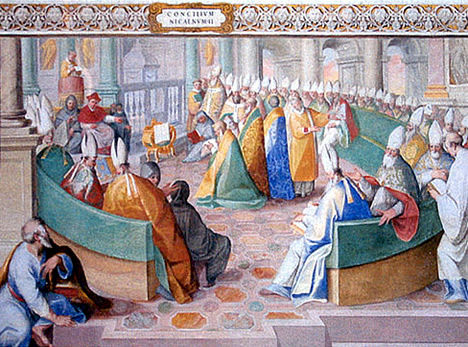
And, in case there was any doubt, the end of the statement denounces Arius and his teachings about Jesus specifically. Then the Emperor exiled Arius and anybody who refused to endorse the creed. By my modern standards of religious liberty that is not a happy ending, but things worked a little differently seventeen hundred years ago.
One tidbit from my study of the “Arian Controversy” in seminary was that this wasn’t just an issue that mattered to the bishops and intellectual elite of the time. People writing from that time claim that, at the height of the controversy, you couldn’t go shopping in the marketplace or stop by any public place of conversation and discussion without hearing people debating about whether or not the Father and Son share one essence. That’s wild.
Today I suspect most Christians would look at some of those unorthodox answers about Jesus and shrug. Are the nitty-gritty details about Jesus’ exact nature and relationship to God the Father really that important? We go to church to hear about grace, about how to have good marriages and raise kids, and to learn what side to take in political debates and on social issues.
And that’s not just snark. One of the most definitive answers in the State of Theology was that 87% of regular churchgoers agreed that “sex outside of traditional marriage is a sin.” That’s been drilled into American Christians very well. Meanwhile most churchgoers don’t think Jesus was God, and that He is a creation of God the Father. I’m not complaining about the traditional Christian sexual ethic being taught, but it’s revealing that people are so clear on that and so unclear about who Jesus might be.
That takes me back to my opening question. Can Jesus be Lord if you misunderstand who He is? This Sunday I taught on the Lordship of Christ from Colossians 1, including a section that is likely an early Christian hymn that upholds Jesus as Lord - our creator and redeemer who has supremacy over all things. But what kind of Lord is Jesus to you if you aren’t clear on whether He is actually God, or if He is some lesser creation of God? How seriously will you take His commands or uphold His teachings if you are like the majority of people who took that survey and don’t believe that Jesus is, in fact, fully God?
When we were studying Arianism in church history class I remember asking whether or not it actually made much difference. If I had been raised in an Arian environment and believed that Jesus was less than God, would I live any differently?

In some ways, maybe not. But there are two reasons why adequate theological training and understanding of high-level beliefs really does matter, and not simply for pastors or teachers but for everyone.
First, the fine details of the Trinity or divinity and humanity of Jesus can affect the way that Christians think and live every day. One example are Christians who believe that women should be subordinate to men in the church, the home, and even in the world at large. There are some of these “hard complementarians” who argue that Jesus is subordinate to God the Father, and therefore it’s not domineering or controlling to insist that women be subordinate to men. That’s closer to Arianism than it is to how the Church has understood the perfect unity of the Trinity of Father, Son, and Holy Spirit.
Second, knowledge of some of these core beliefs matters for Christians because it’s kind of silly to proclaim “Jesus is Lord” and then make no real effort to understand that Lord. That’s not what you do if you’re serious. If you’re going to serve Jesus, seek to imitate Jesus, and put your hope for eternal life in Jesus, you should probably not remain willfully ignorant of who Jesus is.
Study Jesus in the New Testament. Learn what the Church teaches about Jesus. This kind of knowledge, by itself, doesn’t make people holy. And God can do amazing things through people who love Him but haven’t had the opportunity to learn much about who He is. But what does it say about a Christian who has ample opportunity and a wealth of resources to grow their understanding of God and just never bothers? A lack of knowledge often leads to a lack of maturity, and I suspect there are some Christians who like it that way. If their understanding of Jesus is vague it's easier to live counter to the way of Jesus.
I’m going to go through some core beliefs in the “Explain Yourself” series and share more in the coming week - including some thoughts on the authority of scripture next week. Between now and then I encourage you act on one way you could better understand your Lord this week. Pick up your Bible or other helpful book. Read the Nicene Creed or Apostle's Creed. Watch this video about Jesus' name and title and their meaning. If you really want to get into some Biblical nerdiness here is a podcast series about the Son of Man by the Bible Project. Desiring knowledge of Christ is one way to affirm that yes, Jesus is Lord!
Mid-Week Devotional
Let’s continue to reflect on what it truly means to call Jesus Lord and worship Him as our creator and redeemer in this devotional opportunity. Take a moment of quiet first. Stop. Listen. Breath. Invite God to speak in these next few minutes.
John 1:1-5;9-14
In the beginning was the Word, and the Word was with God, and the Word was God. He was with God in the beginning. Through him all things were made; without him nothing was made that has been made. In him was life, and that life was the light of all mankind. The light shines in the darkness, and the darkness has not overcome it.
The true light that gives light to everyone was coming into the world. He was in the world, and though the world was made through him, the world did not recognize him. He came to that which was his own, but his own did not receive him. Yet to all who did receive him, to those who believed in his name, he gave the right to become children of God— children born not of natural descent, nor of human decision or a husband’s will, but born of God.
The Word became flesh and made his dwelling among us. We have seen his glory, the glory of the one and only Son, who came from the Father, full of grace and truth.
Prayer – The Gloria
Glory be to the Father, and to the Son, and to the Holy Spirit. As it was in the beginning, is now, and ever shall be, world without end.
Music
Here’s a lovely little contemporary hymn called “Jesus Is Lord”, written by Stuart Townsend and Keith Getty but performed by some talented folks you’ve never heard of. The lyrics are:
‘Jesus is Lord’ – the cry that echoes through creation: Resplendent power, eternal Word, our Rock, The Son of God, the King whose glory fills the heavens, Yet bids us come to taste this living Bread.
Jesus is Lord – whose voice sustains the stars and planets, Yet in His wisdom laid aside His crown, Jesus the Man, who washed our feet, who bore our suffering, Became a curse to bring salvation’s plan.
Jesus is Lord – the tomb is gloriously empty, Not even death could crush this King of love. The price is paid, the chains are loosed, and we’re forgiven, And we can run into the arms of God.
Benediction
May the LORD bless you and protect you.
May the LORD smile on you
and be gracious to you.
May the LORD show you his favor
and give you his peace.


Comments